
Insurance claims are intended to help people and businesses recover from unexpected losses. However, when a claim contains false information, inflated damages, or an exaggerated injury, determining what actually happened can become difficult. The challenge is even greater when the available evidence appears convincing at first but does not fully support the story behind the claim. This is where a professional insurance fraud investigator can play an important role. Rather than treating every inconsistency as evidence of fraud, an investigator examines the circumstances surrounding a claim, verifies important details, and compares statements with independent evidence.
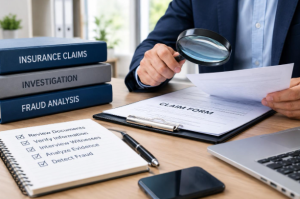
What Makes An Insurance Claim Suspicious?
A suspicious claim is not necessarily a fraudulent claim. Certain circumstances may simply justify a closer look. The significance of these discrepancies depends on the circumstances. A minor difference in someone’s recollection may have a reasonable explanation, while repeated contradictions involving important facts can warrant a more detailed investigation. This distinction is important because the purpose of an investigation is not to label a claim fraudulent based on suspicion alone. It is to determine whether the evidence supports what has been reported.
How Do Insurance Fraud Investigators Identify False Or Exaggerated Claims?
Investigators generally begin by developing a clear understanding of the claim. They review the information already available, identify areas that require verification, and then examine those areas using appropriate investigative methods.
Reviewing The Claim And Available Records
A detailed review of the claim file is often the starting point. This can include the original claim statement, accident reports, photographs, medical records where relevant, repair estimates, invoices, correspondence, and other documentation connected to the loss.
Comparing Statements With Other Evidence
What a claimant reports is only one part of an investigation. Investigators may compare that account with information provided by witnesses, employers, coworkers, property owners, medical professionals, or others who may have relevant knowledge. The focus is on material inconsistencies.
Establishing A Reliable Timeline
A clear timeline can be one of the most useful tools in an investigation. An investigator may examine when an incident allegedly occurred, when it was reported, when medical treatment or repairs began, and what other relevant events took place before or after the loss.
When Are Insurance Claim Investigation Services Useful?
Not every questionable claim requires an outside investigator. Many inconsistencies can be resolved through routine claims handling and additional documentation. More complex cases, however, may require resources and investigative techniques that go beyond a standard review. Insurance claim investigation services can be useful when important facts remain unclear, witnesses need to be located or interviewed, surveillance may be relevant, or the circumstances surrounding a claim need to be independently verified.
Why An Evidence-Based Approach Matters
The strongest fraud investigations are built around evidence rather than suspicion. A claimant may make an innocent error in a statement, misunderstand a question, or have difficulty recalling an event accurately. Similarly, a discrepancy in a document does not automatically indicate intentional deception. Investigators therefore need to consider the context and determine whether the available evidence establishes a meaningful inconsistency. An experienced insurance fraud investigator looks at how different pieces of information fit together.
Choosing The Right Investigation Approach
There is no universal formula for investigating an insurance claim. The right approach depends on the type of loss, the concerns involved, the evidence already available, and what still needs to be established. The value of professional insurance claim investigation services lies in applying the appropriate investigative methods to the specific circumstances of a case. When the investigation is properly planned and documented, the resulting evidence can help insurers and other authorized parties make better-informed decisions.
Conclusion
False and exaggerated insurance claims are rarely identified through a single obvious clue. More often, they are uncovered by comparing different pieces of information and recognizing when the reported circumstances do not align with independently verifiable evidence. A thorough investigation can bring those discrepancies into focus. By reviewing claim records, comparing statements, establishing timelines, examining physical evidence, interviewing relevant individuals, and using surveillance when appropriate, investigators can build a clearer picture of what actually occurred.
Leave a Reply
You must be logged in to post a comment.